THE PRICE OF PEACE.
It was a freezing morning in Oslo when I visited the Oslo City Hall with my parents. I was expecting an imposing seat of power with intricate gothic details carved on to the building, especially since it is the annual host of the Nobel Peace Prize ceremony. The glimmering clean and modernist architecture in the neighborhood overlooking the Oslo Docks only heightened my expectations, yet the City Hall building was a letdown. The building was brick red and featured a clock, while the interior was adorned by murals in a rather empty hall. I wondered, for the host of the Nobel Peace Prize ceremony, this building was underwhelming. Where was the exclusivity which was attached to anything important and highly respected?
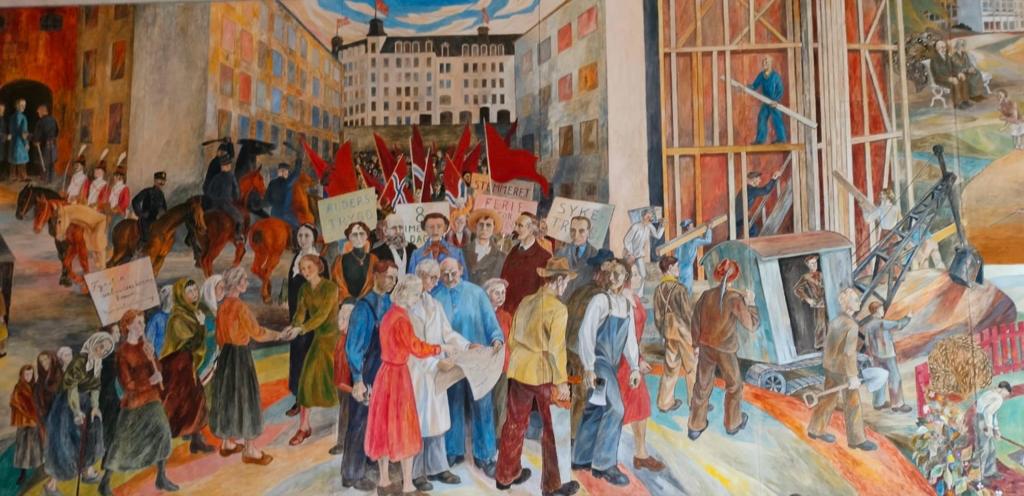
The murals answered. They showed scenes of communal harmony. They portrayed the muscled laborers of the city as proud, high and deservedly so. The heroes of the epic of the city of Oslo were not mythical warriors or royalty who decreed the construction of grandiose monuments, but they were instead the workers who made those monuments with their bare hands, and they were the chief guests. The stories portrayed were of life, death, marriage, revelry, hardship, rebellion against Nazi occupation, and the stars were the extraordinary citizens of Oslo. The stories were of solidarity. The murals reflected the psyche of the population of a country held as a model in human development for the rest of the world. This was an individualistic society, but not a selfish society. The welfare of the population was the responsibility of a government which imposes high taxes, and doles out higher welfare schemes. They are not despised as free handouts by the populace, but they are thought of as responsibility to ensure basic necessities and dignity to fellow compatriots. This was a society where an unlocked door does not invite thieves, but trust. This was a utopia in reality, this was a society in peace.
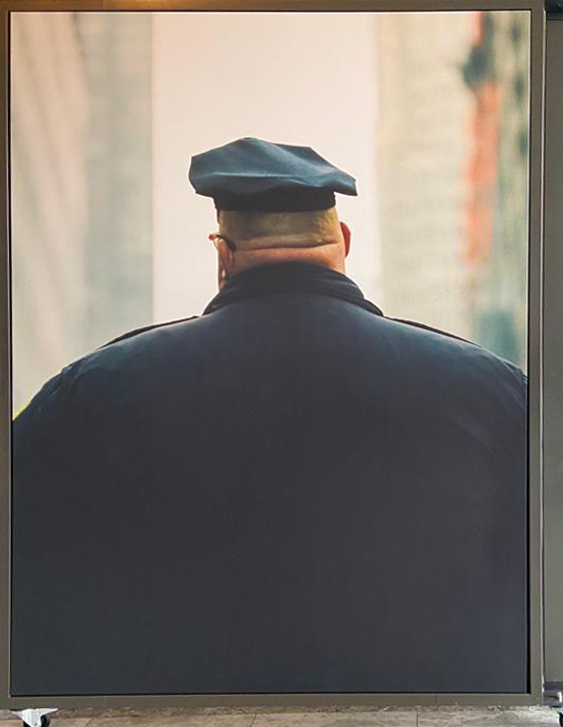
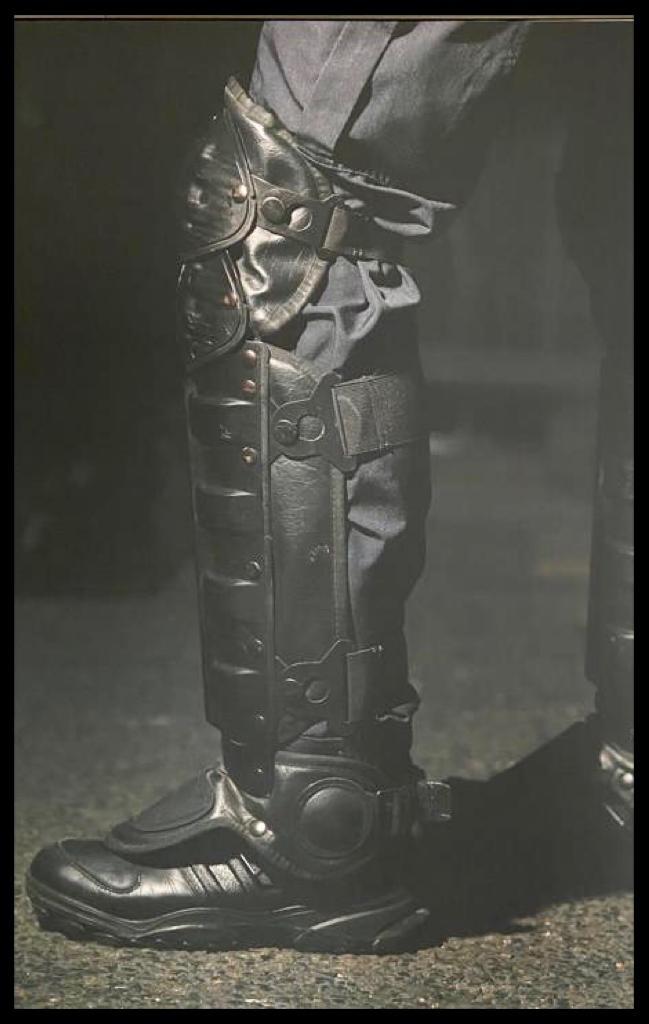
There was an exhibition, if you will, displaying the various protests, uproar against political and social oppression around the world. They featured masked protesters fighting against the mask which silences them, a single yet hefty police boot adorned with a dark, metallic brace enough to strike fear and pain to those who dare to go against, the massive figure of a policeman turning his back to the viewers and the people, masked protestors fighting for freedom of expression and dignity. The answer to why Oslo hosts the Nobel Peace Prize was clear to me: dissent is respected and taken for granted. This accommodation, this lack of brute force gagging the voice of the people has brought peace. Peace in such a society is not merely order imposed by a higher power, but a mutual, unanimous willingness to live and let live, and I feel that we should strive to achieve that kind of peace. Peace should be one of dignity, freedom to talk responsible and one of mutual respect, not one where silence and immobility through gags and shackles is confused for peace.
Humanity is one of imperfection and double standards, and I will not pretend to be different. I have also relished thoughts of silencing a few voices I felt not worthy of being heard of. Though one must act responsibly, without endangering the liberty and dignity of others, there must be a less biased filter of judging which voice is seditious and harms order, or more importantly peace. Peace, for me thus, is freedom and equal dignity to all those who deserve it regardless of external characteristics which do not define and decide a person’s worth, values and behavior. The struggle for liberation is one which has occurred countless times in the past, are still ongoing, and shall continue into the future. That struggle is barely ever non-violent. Blood has been spilled in these revolutions, rockets still fire instead of crackers of celebration, to maintain “order”. Peace is born from chaos, and order is an illusion.
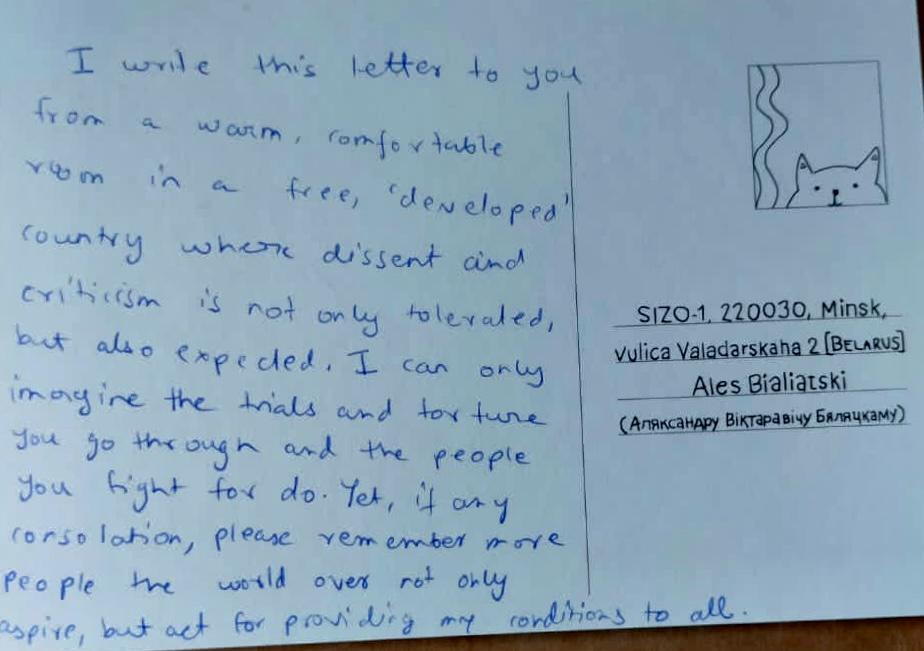
Ales Bialitski is a Belarussian pro-democracy activist. He has worked to promote democracy and human rights in Belarus since 1980s, the only continental European country which is not a democracy. He fights for dignity and freedom for his people, for true peace. Yet the Peace Prize winner is jailed by the tyrant of his country instead of being honoured. The city hall had provisions to send postcards to this wronged participant in his country’s struggle for liberation. I did feel guilty, as writing a mere postcard is vastly different from braving police batons and hoses to bring about said liberation. Yet, I felt, in my pain of not experiencing enough pain (if that makes sense), that if writing a mere postcard which may not even wind up in his cell to restore his faith in the struggle he believes in may make a difference, no matter how miniscule, then I shall write him a postcard to his, I believed cold jail cell, from my insulated surrounding, wearing a fuzzy jacket.
This was my first, no matter how distant, interaction with a real-time political struggle. This mere composition of a postcard had reinforced my commitment to study human society, its intricate governance to a great deal, reinforcing my fascination with the good, the ugly and the terrible of the human race. I felt that the future is human, a future of peace which we can achieve against all odds.
Humanity has the ability to destroy itself. Humanity has the Holocaust, the Rape of Nanking and the Rwandan Genocide. Humanity also has the highest capacity to save itself from the most imminent of disasters. Humanity has the UNICEF, Ales Bialitski, Schindler and the kind neighbor next door. Humanity has the love of power which makes me pity the world, while humanity has the power of love which makes me want to preserve this world by all means.
I believe that before a wildfire or a tsunami, humanity has the most capability to destroy itself from within. I also believe that humanity is the most capable of removing factory farming, animal abuse, Apartheid anywhere in the world, as we have been proven to do so. Whatever the price of peace, humanity can pay it.
 Ishaan Nag - My diary of the human society.
Leave a comment