• Hedge funds, stock markets and the world of finance and trading is generally associated with glamorous selfishness, and those who partake in them are often stereotyped in movies as greedy snakes. In the meantime, however, it is often forgotten that money is merely a means to an end, and that end could be charitable too.

    Charities are voluntary contributions to just causes. Charity has an intrinsic value in and of itself, but humanity is not intrinsically inclined to these causes, because most of us are egoistic rather than altruistic regardless of outliers. People need incentives to act, and that’s okay. There are millions of Non Profit Organizations and people around the world who are dedicated to these causes and know how to solve complex problems, which most of us don’t have the ability to, but the intention. Sometimes all that is needed is a little bit of extra support, be it in the form of commodities, time, or finances. The latter part is particularly worth exploring.  

    Many countries possess very well known tax benefit policies for contribution to charities, such as tax deductibles as benefits for donors contributing to 501(c ) organizations in the US, and tax benefits for  gains from assets held by charitable trusts in India. If more than 85 % of income of trusts or charities are not applied, that income can be accumulated and hence, tax exempt. Yet even more intriguing than government ensured rules and policies is the free market’s own ability to support good causes.

    The Indian finance minster said, “It is time to take our capital markets closer to the masses and meet various social welfare objectives related to inclusive growth and financial inclusion”.  This is  the Social Stock Exchange, an initiative to connect the stock exchange system with Non Profit organizations, facilitating them to raise money from donors without explicit door-to-door requests to them. The Indian securities regulator SEBI has permitted the Bombay Stock Exchange to set up this social stock exchange, wherein organizations with a motive to do good can raise funds. Charitable ‘trading’ through the SSE is also more beneficial for the donor as it has more tax benefits than direct donation.

    The way in which the SSE works is through the issuance of Zero Coupon Zero Principal Bonds by participating charities. These are bonds issued to, or loans given by the donor to the charities, which, however, do not gain interest yield. Moreover, the principal amount is not paid back to the donor either. Since the audits regarding this exchange goes public like the normal stock exchange, we know that the funds are used for the right purposes.  

    Some mutual funds such as HDFC Charity Fund for Cancer Cure also work in a way similar to ZCZP Bonds. Like normal mutual funds, they are invested a principal amount by donors, which gain assets tax-free. However, the interest is paid only to charitable organizations of the donor’s choice, while the principal is paid back to the donor after 3 years. Moreover, some organizations which are not quite NPOs but raise funds for charitable causes, known as For Profit Social Enterprises (FPSEs) could also be listed in the SSE. These FPSEs can raise capital in exchange for equity. Profits generated through this trade can be reinvested into supporting their just cause. Investors need not necessarily deem monetary returns as the prime reason for investing in FPSEs as they are investing for a social cause anyways, and thus may be willing to invest in these organizations regardless of potential returns.

    One of the biggest issues which prevent people from donating is the information asymmetry arising from monetary exchange between donors and charities. There is a lack of transparency regarding where and how money is spent, and thus a lack of accountability, deterring people from donating to charities which are not very well-known. This situation can be improved through the Social Stock Exchange as finances are automatically audited under the guidelines and watchful eye of the SEBI, thus increasing transparency and trust.

    However, challenges exist with this system. India is not the first to initiate the SSE, and other countries such as Brazil have done so in the past to, only to be rendered insignificant. This is due to the lack of scalability. Smaller charities have limited access to the SSE, hence losing out on raising more funds for a good cause. Democratization for NPOs to access funds has not been carried out fully, and that thorn must be plucked for a truly effective SSE, to truly prove that the glamorous world of stocks and funds can be used as a means to good ends.

  • The thing with insurgents inside a country is that more often than not, it involves sneaky guerrilla warfare tactics which involve civilians, with them being caught in the crossfire. And of the insurgents who do get neutralized, the punishment dished out to said insurgents overcompensate. Examples such as Russian government against the Chechens, the Sri Lankan army against the LTTE and the PRC government in Xinjiang are galore and obvious. This doesn’t mean counterinsurgency should stop altogether, because insurgents do threaten the internal security and integrity of legitimate state power (key word-legitimate) and doubtlessly require neutralization. However, I argue that counterinsurgency efforts should be humane, as in, the retribution received should not exceed Geneva Convention laid punishments.

    Counterinsurgency is a kind of irregular warfare, such that there is no conventional military standoff but nor a nuclear war. However, most states fail to master irregular warfare combat, though this varies, and thus leads to somewhat higher casualties than usual. The assymetrical warfare which ensues, as the governments which clearly have much greater resources than insurgents yet do not vanquish the insurgents quickly and instead leading to a long drawn out war, is frustrating and clearly, the animosity towards such insurgents is higher. Moreover, there is also the element of taking civilian hostages, collateral damage to their life and property, and also in the case of localised insurgency, a lack of complete information being provided to the citizens of the rest of the nations, which makes it very easy for sections of the population to be very polarized about such movements.

    Often, insurgents attract civilians to their cause, in large numbers, too. Retribution from governments cause a boomerang effect, as when excessive, it only makes the problem worse and inspire another regiment of civilians to join the fray. This might sound cliché but most counterinsurgency efforts by government fall flat or are much more costly, both on lives and finances, as they do not uproot the causes of insurgency yet merely quash their symptoms. Counterinsurgency efforts must thus focus on developing cultural understanding of the troubled regions and empathy with the prevailing social conditions. This should come off as obvious, yet this is rarely implemented, and I cant observe any obstacle which prevents this basic measure apart from a lack of will.

    Given that insurgents engage in violence in very unconventional ways (irregular warfare, as previously mentioned), it is very easy to enforce extrajudicial penalties on insurgents and those aiding them. Incentivizing them to engage in conventional warfare which does not involve civilians, not cause collateral damage and conduct themselves according to the “rules of war” as set by the international community can help highlight extrajudicial penalties, and encourage civilized forms of punishments. In fact, Francis Lieber through his General Order no.100 or the “Lieber Code” had a great influence in the international community at The Hague and Geneva in incentivizing the regularization of insurgents and guerrilla militias, by codifying the laws of war. Of course, merely codification is far from implementation, and history has proven us so. But also it is substantial in considering that codification laid the groundwork for a new and more civilized approach to the conduct of the war, and hopefully will continue to do so, hence changing popular attitudes to how war should be conducted.

    As for the state’s role in its conduct in counterinsurgency, one of the other identifiable reason for the usually brutal nature of required counterinsurgency is the line of thinking, wherein when the insurgent engages in morally reprehensible practices such as using civilians as human shield from attacks,  the obligation for the counterinsurgent to abide by morally acceptable conduct of war is discounted and excused. Court marshals against these practices may be strengthened, along with the previously explored broadcasting of complete information to the rest of the country regarding the situations in these insurgency affected areas.

    In order to ensure that states too engage in conventional warfare, there needs to a requirement for the intrinsic nature of the state- to be legitimate and have a moral dimension to its security policy, but not necessarily pacifist. Even with the example of the USA, the bogeyman of radical theorists, anti-neoliberals, anti-colonial theorists and so on and so forth, it is undeniable that the socio-political foundation of the country has led to its foreign policy having a moral policy, with of course very notable exceptions, but again, with undeniable examples such as its post war efforts in restructuring the economies of its opponents of the second world war, its current anti war stance on the Israel-Hamas conflict, and more. As long as the basic structure of a nation is moral and democratic, and as long as it derives its legitimacy from these values, we may not be amiss in assuming that self restraint in counter insurgency operations would be present.

    Thus, I feel, the fulfilling of basic conditions of moral and democratic legitimacy from the state’s side and successful incentivizing of insurgent to engage in conventional warfare has the best chance at achieving humane and effective counterinsurgency.

  • On February 2024, the Indian Supreme Court ruled that political parties could no longer receive political funding from electoral bonds, striking it down as unconstitutional, a measure touted as a mostly clean and accountable method to receive political funding by the ruling BJP, which introduced the scheme back in 2018. Fast forward to the 2019 general elections and the present, and we have seen that the Election Commission of India (ECI) itself raised doubt about its transparency in its affidavit claiming that “the scheme is contrary to the goal of transparency in political finance”, also sharing a letter to the Union Government outlining its impact on the transparency of political funding. Several parties have moved the SC against the electoral bond scheme, prominent among which is the pro-democracy NGO Association of Democratic Reforms (ADR), and this eventually resulted in the effective termination of the scheme, much to the rejoice of the opposition parties and pro-democracy organizations and institutions, which begs a few questions: what is the electoral bond scheme which justifies its controversy? Why is its result of further opacity contradicting its supposed intention of higher transparency? Why is the opposition rejoicing? And finally, is there a better option? Were previous methods any better?

    Electoral bonds are instruments wherein the bearer (political parties) is paid a certain amount on demand by the payer, who are according to this scheme, any Indian citizen and domestic or foreign organization. It was introduced in The Finance Bill of 2017 during the Union Budget as the Anonymous Electoral Bond scheme.  Its rationale was that the veil of anonymity regarding from who or what political parties sourced their funding made them less susceptible to be swayed by their interests, hence increasing accountability. It was facilitated by amending legislation to allow foreign funding of parties by finance act 2016. Moreover, amendments to the  Income Tax Act ensured it wasn’t  required for political parties from keeping a detailed record of funding received from the scheme. The cap on maximum donations made by companies to political parties was removed. Previously “companies could only donate up to 7.5 percent of three years of the company’s net profits”.

    The government also argued that since funding was done through the formal banking system, as the SBI was the sole authority in raising these bonds, there was less chance for foul play. This, however, was also flawed, as the SBI being directly under the control of the government, gave the ruling party a further advantage in the acquisition and concealing of information pertaining to the electoral bonds. Thus, any plan to devise a fair method of political funding was flawed at best and ostensible at worst. The striking down of the electoral bond system was hailed by Indian political institution such as the ECI, NGOs such as the ADR, and even opposition political parties such as the Left Democratic Front (which, in fact, was one of the parties which moved the SC against the scheme) and the INC, which in fact promised in its manifesto for the 2019 general elections to remove the scheme if voted. So why the opposition from the opposition?

    Firstly, there are concerns about the growth of a political oligarchy similar to Russia, if you will. The first cycle of electoral bonds showed that 85% of the bonds were purchased in the denomination of Rs 1 crore. This trend continued throughout the existence of the Scheme. Till January 2024, 15,631 electoral bonds worth Rs 15,631 cr were purchased in this denomination, which is more than 94% of the total bonds sold during all the phases. The large denominations of the purchase indicated that it was the conglomerates which bought most of the electoral bonds, which could have resulted in higher influence of corporates, thus giving political priority to corporations over the individual citizens and their interest. So, electoral bonds have been shown to erode the Right To Information Act and the principle of transparency  which is so crucial and intrinsic to the functioning of a legitimate democracy, hurting the so-called Social Contract between the individual and the state. It also ran the risk of promoting an oligarchy in the political system, and some may argue has somewhat succeeded, though not necessarily due to the electoral bond scheme, with the growing public discourse on the seemingly symbiotic relationship between the Adani corporation and the current administration. However, Indian politics has historically always been swayed by powerful individuals and organizations influencing the government to act in their interest, even in previous governments of the current opposition. But I digress.

    The LDF and the INC have also both shown  their disapproval of the scheme, and it is understandable why. The Electoral Bond scheme seems to have denied the opposition parties a level playing field in the area of political funding. BJP’s received 74 percent of bond yields among national parties,  while among both national and state parties both, the share was 57%. Electoral Bonds thus decreased the level playing field between political parties.

    Given these disadvantages, it seems any other form of funding is better, even the previous methods, though they are not without their limitations. Let us take the example of electoral trusts, which ensure funding solely through the banking system, and “disclose the details of political contributions to beneficiary parties through the regular filing of annual reports and the link between the political party and the donor can be traced by the Election Commission”, although the information is not revealed to the public. One of the main arguments for the Bond scheme which argues that funding through the banking system would result only in white money funding is hence redundant, for the system was already in place and Electoral Bonds were, in this regard, nothing novel.

    However, even through this system, Indian politics were still susceptible to unwanted influence. In March 2014, the Delhi High Court had held both the Congress and the BJP guilty of taking foreign funding from Vedanta and its subsidiaries. The then INC government and the opposition of BJP in a shameless example of collusion, amended legislation such that the illegalities resulting from their respective sources of political funding were removed.

    I argue not that the previous system was good, but that it was better. Structural flaws in the form of foreign funding and opacity persist with both the methods of funding, but as explored, legislation gave these unfair practices legitimacy in the case of Electoral Bonds. Our take home as perceptive citizens may be the lesson that legislation does not equal legitimacy. In some cases, legislation makes us worse off for its much harder to overturn a bad practice, in the case of the electoral trusts and its misgivings, the amendments to the Foreign Contribution Regulation Act which removed the illegalities of political funding resulted in both the BJP and Congress escaping scot free from the verdict of the Delhi High Court. The bench of justices led by Chief Justice DY Chandrachud of the Supreme Court appropriately took the verdict of striking down the Electoral Bond scheme, but it was, in fact, operational for 6 odd years from 2018 to 2024 February. It was a lucky situation that good sense prevailed, but good sense can’t be relied on indefinitely. At some point, institutional and structural changes are the only way out. This is especially true in the case of aforementioned monetarization of politics.

  • I hail from the region of Bengal in Eastern India, the land of fierce feminity and its celebration, which takes the form of a much-awaited yearly ten-day long festivity, the Durga Pujo. It’s pomp is equivalent to Christmas in Christian majority nations, Nowruz, Eid and Dia de los Muertos altogether, or rather, given the stampedes and Pandals, and the flock of people exploring the streets of the city for festive joy with the strength of entire nations, lacking an equivalent in the first place. Given the tremendous scale of these festivities, it is no wonder that the extent to which the economy of a region is both invigorated and disaffected with increased consumption, production, money flows and their leakages, is tremendous . Much like the Olympics, the economic cost and benefits of such festivals are something worth discussing.

    Let me take the example of the festivity of my home turf, the Durga Pujo. In 2022,  The West Bengal State Exchequer had spent Rs. 60000 per Puja committee (clubs organizing the festivities of different neighborhoods). West Bengal had a total of 40092 Puja committees, which meant a total expenditure of Rs. 220,55,20,000. The chief minister was quoted in 2022 saying, “The State Treasury is empty. But I hope Maa Durga will fill up our treasury. Last year, we had given Rs. 50000 to each Puja organizer. This year we are increasing it to Rs. 60000 to each club”. This was a public admission of the lack of funds in the State treasury due to extreme expenditure and provision of subsidies for non-necessity purposes. However, the tremendous spending was also matched by corresponding increase in consumption and overall bolstering of the provincial economy. In fact, the Bengal Durga Pujo economy crossed the Rs. 5000 crore mark, a 54 percent increase from the 2019 findings of Rs. 32377 crore by the British Council, IIT KGP, and Queen Mary’s University (in which retail accounted for  80-85 per cent of the total Durga Puja economy, and the food and beverages sector had a share of around 7-8 per cent, while erection of marquees, decorations, lighting, entertainment, advertising and others accounted for the rest, according to The Business Standard.). The festivities accounted for 2.58 percent of the state GDP in 2019 according to a study by the British Council for the West Bengal government, and only grew as a percentage in the post-covid year of 2022. “Compared to the length and breadth of Durga Pujas, we are sure that its contribution to the state economy is either at par or bigger than the contribution of Rio de Janeiro carnival to the Brazilian city’s economy, and the cherry blossom festival in Japan,” said Debanrayan Sarkar, a former professor and economist at Presidency University”.

    Given that the phenomena of this huge boost in the local economy in and around the period of festivities is mostly a consumption-led activity, the positive spillover effect justifies the government spending accompanying this cultural activity, as the festival effect leads to an upsurge in employment of mostly irregular labour, cottage industry workers, and a general increase in employment guided by increase in production caused by a surge in consumption.

    However, my point lies on the specific “spillover effect” created by festivals instead of pure monetary gains and losses, the social satisfaction, the intangible aesthetics and emotions which are nearly as important as food, clothing and shelter, and just as important as transport infrastructure, industrialization, and various other traditionally economically benefitting activities.  A watch or a new car can do no good to a person perpetually dissatisfied spiritually or mentally, thus representing a failure of rational consumer behavior.

     Positive externality is a benefit received by the stakeholders of an economy, as an indirect effect of the activities of another actor. They  arise when one party, such as a business, makes another party better off but does not receive any compensation for doing so, as a spillover effect on society as a whole, thus benefitting the society as a social benefit. It is usually exemplified by reduction in pollution, consumption of healthier products, and a generally cleaner, healthier and “better” (subjective term) environment and society. However, even though positive externalities are beneficial to society, are categorized as market failure in economics. This begs the question: are economic costs and benefits, price mechanisms and strict adherence to ruinous equilibriums all that matter?

    The economies of the world and how we perceive and achieve solutions, or rather, the choice of problems we identify to be fixed, is in some cases flawed. We prioritize the tangible over the intangible, scorn the increased funding for public media, cultural events, and praise the increased spending for roads and bridges. While the latter has almost unanimous reason for celebration, the former receives scorn in an unjustified degree.

    Are we becoming grey, not due to complexity but due to monotone? With the advent of AI and incidents such as the Writer’s Strike in the USA, are we placing decreasing importance on pleasure and leisure? We must treat intangible spiritual satisfactions as positive externalities but not as market failure, as it is anything but so. Though these phrases have been exasperatingly used countless times, I feel that they are worth repeating- let us make art instead of more programming and robots. Let us chase rational consumer satisfaction as well as spiritual satisfaction. Let us buy , but let us cherish more. Let us celebrate externalities if they are positive, let us celebrate market “failure” if they allocate the intangible resource of spiritual satisfaction.

  • The Stanford Prison Experiment was a psychological experiment conducted for 6 days  by American psychologist Phillip Zimbardo. In the experiment, a prison environment was simulated, and volunteers signed up either as the imprisoned or the jailers. The experiment aimed to investigate the effect of social expectations and imposed roles of authority on individuals. Among the selected volunteers, half were assigned as prisoners while half were assigned as prison guards randomly. The volunteers designated as prison guards were ordered not to abuse the prisoners and were made to wear mirrored sunglasses. The prisoners were subjected to several practices which sought to harm their dignity, in order to simulate a prison environment.

    The prisoners rebelled against the  guards on the second day. The guards made a system of rewards and punishment to contain the rebellion, and sprayed fire extinguishers on the prisoners. Over the course of the experiment, the guards became increasingly abusive, and used increasingly cruel tortures on the prisoners, such as forcing prisoners to simulate sexual situations with each other, taking food privileges away and forced the prisoners to insult one another. The volunteers sunk more and more into their imposed role of tyranny as well as submission, as the prisoners were reported to not even considering their own rights and dignity. The experiment became increasingly fatal, and thus, on ethical grounds, was prematurely terminated after only 6 days, as for many prisoners the situation became fatal, with the prisoners experiencing extreme mental and emotional degradation, one of the prisoners reportedly becoming hysterical in Dr. Zimbardo’s office.

    This haunting experiment is but a mere glimpse on the capacity for cruelty humanity has, regardless of one’s usual behaviour, perspectives, values and morals. A random  sample of volunteers uniformly sank deep into the traits of their respective, imposed roles of submission and tyranny. The experiment reinforced the claim that “evil”, tyrannical behaviour was often a result of situational context.

    I feel that the roles we, as humanity in general, have associated with different social classes, professions and positions. To be the police is to be authoritarian, to be a politician is to be amoral and “weasely” at best and criminal at worst. To be a manual labourer, scavenger, or one of the several trades is to be “lowly”, submissive, and dismissive of when addressed towards with the pronouns indicating the least formality and in some contexts, respect, at least in India. Of course, like with every case, this generalization also possesses exceptions, but in general, does seem to hold true. Their reputation matches their reality. My focus is how students, the generation which carves the society, politics, progress, regress and even the future of a nation, fare with this generalization, with special emphasis on student, especially student union politics.

    Of course, student unions, like most labour unions, are in theory a great way to prevent oppression and pursue the common interest of a group united in its class and societal role. Student unions are a great idea in incorporating democratic values in the new generation of a country. These unions enable students to have a voice in the administration of educational institutions, check exploitation, give a platform for representation of various groups of students, and provide an opportunity for resource allocation and aid, financial or mental, much like a cooperative.

    The voices of student union members in most major universities is one advocating self-expression and of democracy. The same goes for student bodies in school. Yet, once a member does occupy a position of leadership, the voice of freedom changes into one of autocracy, one for liberation changes into one of absolute control. In fact, The Independent People’s Judicial Inquiry Commission led by  Justice P K Shamsuddin  has found that most student unions in the state of Kerala are autocratic; most colleges with such unions have  Idimuris, which are rooms where union office-bearers beat up those opposed to them, comparable to the jailers in the Stanford Prison experiment

    The Akhil Bharatiya Vidyarthi Parishad (ABVP), the student union and student wing of the RSS had established itself as a pro-democracy and anti-authoritarian students union during the Emergency period, and along with the NSUI (student union affiliated with the Indian National Congress), was one of two dominant student unions in the Delhi universities. Its anti-establishment rhetoric reached a peak with the arrest of former ABVP union leader and later Union Finance Minister Arun Jaitley during the Emergency period in India in the 70s. Yet, as it dominated the union positions in the universities of Delhi in recent years, it has abandoned its commitment to democracy and free speech with alarming readiness, with its intolerance of opposing ideas symbolized by simplistic attacks of labelling opponents as “anti-nationals”. The union which once, when not in power and endangered by authoritarian rule, sought to counter autocracy and a silencing regime, turned out to be the very same thing it sought to destroy. It has become the union which has suppressed the voice of detractors, the advocates of free speech have turned to protests to deny and cancel a seminar at Ramjas college in Delhi, where JNU students Umar Khalid and Shehla Rashid Shora were to participate.

    Our perceptions of jobs often influence such social behaviour. Student union leadership itself, as we have seen in previous examples, turn to establish absolute authority over student affairs. The voice of rebellion, the anti-establishment student voice changes to one demanding absolute loyalty and to act with absolute impunity.

    I must not be perceived as being biased against an ideology, for leaders, unions, organizations and individuals everywhere, across, nations and social systems have turned to this abandonment of ideals, of  resisting and expressing spite of unbridled power, while exercising it themselves when they are in authority, although in varying degrees, checked only by a system of accountability powered by the search for power of other groups keeping the establishment in an equilibrium of amoral, selfish lust for power with a facade of preserving democracy. Though I unfortunately lack a scientific cure-all for such power equations, I feel that we can start by attaching different roles and more responsibilities to these positions of authority. Let us not think of the police officer as our master, but as a responsible fellow citizen with an important job for ensuring law and order, deserving of punishment when acting with impunity. If we are in the Prison Experiment, the prisoners aware and fighting for their rights, and the jailer respectful and possessing a moral compass, the experiment would dissolve.  Let us change our attitudes to change our societies, and let us start as students, the new generation.

  • THE PRICE OF PEACE.

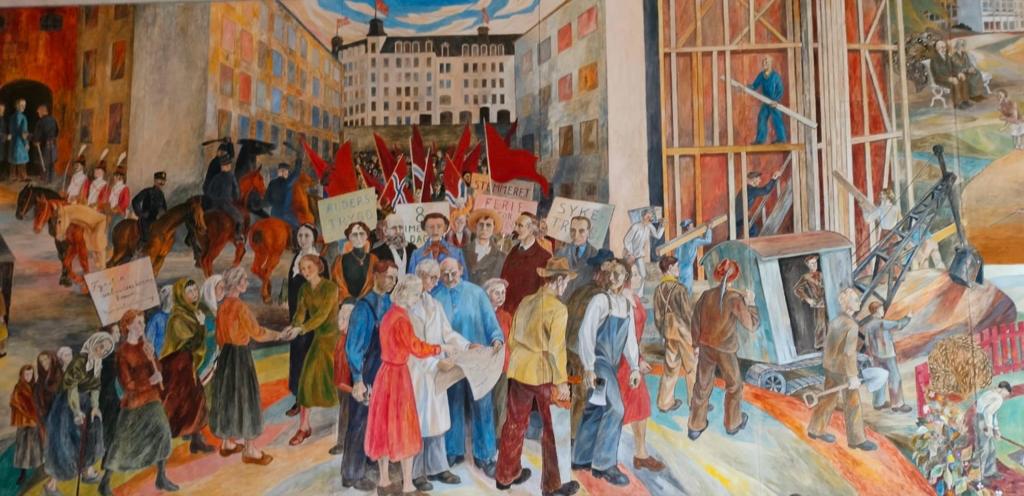
    It was a freezing morning in Oslo when I visited the Oslo City Hall with my parents. I was expecting an imposing seat of power with intricate gothic details carved on to the building, especially since it is the annual host of the Nobel Peace Prize ceremony. The glimmering clean and modernist architecture in the neighborhood overlooking the Oslo Docks only heightened my expectations, yet the City Hall building was a letdown. The building was brick red and featured a clock, while the interior was adorned by murals in a rather empty hall. I wondered, for the host of the Nobel Peace Prize ceremony, this building was underwhelming. Where was the exclusivity which was attached to anything important and highly respected?

    The murals answered. They showed scenes of communal harmony. They portrayed the muscled laborers of the city as proud, high and deservedly so. The heroes of the epic of the city of Oslo were not mythical warriors or royalty who decreed the construction of grandiose monuments, but they were instead the workers who made those monuments with their bare hands, and they were the chief guests. The stories portrayed were of life, death, marriage, revelry, hardship, rebellion against Nazi occupation, and the stars were the extraordinary citizens of Oslo. The stories were of solidarity. The murals reflected the psyche of the population of a country held as a model in human development  for the rest of the world. This was an individualistic society, but not a selfish society. The welfare of the population was the responsibility of a government which imposes high taxes, and doles out higher welfare schemes. They are not despised as free handouts by the populace, but they are thought of as responsibility to ensure basic necessities and dignity to fellow compatriots. This was a society where an unlocked door does not invite thieves, but trust. This was a utopia in reality, this was a society in peace.

    There was an exhibition, if you will, displaying the various protests, uproar against political and social oppression around the world. They featured masked protesters fighting against the mask which silences them, a single yet hefty police boot adorned with a dark, metallic brace enough to strike fear and pain to those who dare to go against, the massive figure of a policeman turning his back to the viewers and the people, masked protestors fighting for freedom of expression and dignity. The answer to why Oslo hosts the Nobel Peace Prize was clear to me: dissent is respected and taken for granted. This accommodation, this lack of brute force gagging the voice of the people has brought peace. Peace in such a society is not merely order imposed by a higher power, but a mutual, unanimous willingness to live and let live, and I feel that we should strive to achieve that kind of peace. Peace should be one of dignity, freedom to talk responsible and one of mutual respect, not one where silence and immobility through gags and shackles is confused for peace.

    Humanity is one of imperfection and double standards, and I will not pretend to be different. I have also relished thoughts of silencing a few voices I felt not worthy of being heard of. Though one must act responsibly, without endangering the liberty and dignity of others, there must be a less biased filter of judging which voice is seditious and harms order, or more importantly peace. Peace, for me thus, is freedom and equal dignity to all those who deserve it regardless of external characteristics which do not define and decide a person’s worth, values and behavior. The struggle for liberation is one which has occurred countless times in the past, are still ongoing, and shall continue into the future. That struggle is barely ever non-violent. Blood has been spilled in these revolutions, rockets still fire instead of crackers of celebration, to maintain “order”. Peace is born from chaos, and order is an illusion.

    Ales Bialitski is a Belarussian pro-democracy activist. He has worked to promote democracy and human rights in Belarus since 1980s, the only continental European country which is not a democracy. He fights for dignity and freedom for his people, for true peace. Yet the Peace Prize winner is jailed by the tyrant of his country instead of being honoured. The city hall had provisions to send postcards to this wronged participant in his country’s  struggle for liberation. I did feel guilty, as writing a mere postcard is vastly different from braving police batons and hoses to bring about said liberation. Yet, I felt, in my pain of not experiencing enough pain (if that makes sense), that if writing a mere postcard which may not even wind up in his cell to restore his faith in the struggle he believes in may make a difference, no matter how miniscule, then I shall write him a postcard to his, I believed cold jail cell, from my insulated surrounding, wearing a fuzzy jacket.

    This was my first, no matter how distant, interaction with a real-time political struggle. This mere composition of a postcard had reinforced my commitment to study human society, its intricate governance to a great deal,  reinforcing my fascination with the good, the ugly and the terrible of the human race. I felt that the future is human, a future of peace which we can achieve against all odds.

    Humanity has the ability to destroy itself. Humanity has the Holocaust, the Rape of Nanking and the Rwandan Genocide. Humanity also has the highest capacity to save itself from the most imminent of disasters. Humanity has the UNICEF, Ales Bialitski, Schindler and the kind neighbor next door. Humanity has the love of power which makes me pity the world, while humanity has the power of love which makes me want to preserve this world by all means.

    I believe that before a wildfire or a tsunami, humanity has the most capability to destroy itself from within. I also believe that humanity is the most capable of removing factory farming, animal abuse, Apartheid anywhere in the world, as we have been proven to do so. Whatever the price of peace, humanity can pay it.