• Hedge funds, stock markets and the world of finance and trading is generally associated with glamorous selfishness, and those who partake in them are often stereotyped in movies as greedy snakes. In the meantime, however, it is often forgotten that money is merely a means to an end, and that end could be charitable too.

    Charities are voluntary contributions to just causes. Charity has an intrinsic value in and of itself, but humanity is not intrinsically inclined to these causes, because most of us are egoistic rather than altruistic regardless of outliers. People need incentives to act, and that’s okay. There are millions of Non Profit Organizations and people around the world who are dedicated to these causes and know how to solve complex problems, which most of us don’t have the ability to, but the intention. Sometimes all that is needed is a little bit of extra support, be it in the form of commodities, time, or finances. The latter part is particularly worth exploring.  

    Many countries possess very well known tax benefit policies for contribution to charities, such as tax deductibles as benefits for donors contributing to 501(c ) organizations in the US, and tax benefits for  gains from assets held by charitable trusts in India. If more than 85 % of income of trusts or charities are not applied, that income can be accumulated and hence, tax exempt. Yet even more intriguing than government ensured rules and policies is the free market’s own ability to support good causes.

    The Indian finance minster said, “It is time to take our capital markets closer to the masses and meet various social welfare objectives related to inclusive growth and financial inclusion”.  This is  the Social Stock Exchange, an initiative to connect the stock exchange system with Non Profit organizations, facilitating them to raise money from donors without explicit door-to-door requests to them. The Indian securities regulator SEBI has permitted the Bombay Stock Exchange to set up this social stock exchange, wherein organizations with a motive to do good can raise funds. Charitable ‘trading’ through the SSE is also more beneficial for the donor as it has more tax benefits than direct donation.

    The way in which the SSE works is through the issuance of Zero Coupon Zero Principal Bonds by participating charities. These are bonds issued to, or loans given by the donor to the charities, which, however, do not gain interest yield. Moreover, the principal amount is not paid back to the donor either. Since the audits regarding this exchange goes public like the normal stock exchange, we know that the funds are used for the right purposes.  

    Some mutual funds such as HDFC Charity Fund for Cancer Cure also work in a way similar to ZCZP Bonds. Like normal mutual funds, they are invested a principal amount by donors, which gain assets tax-free. However, the interest is paid only to charitable organizations of the donor’s choice, while the principal is paid back to the donor after 3 years. Moreover, some organizations which are not quite NPOs but raise funds for charitable causes, known as For Profit Social Enterprises (FPSEs) could also be listed in the SSE. These FPSEs can raise capital in exchange for equity. Profits generated through this trade can be reinvested into supporting their just cause. Investors need not necessarily deem monetary returns as the prime reason for investing in FPSEs as they are investing for a social cause anyways, and thus may be willing to invest in these organizations regardless of potential returns.

    One of the biggest issues which prevent people from donating is the information asymmetry arising from monetary exchange between donors and charities. There is a lack of transparency regarding where and how money is spent, and thus a lack of accountability, deterring people from donating to charities which are not very well-known. This situation can be improved through the Social Stock Exchange as finances are automatically audited under the guidelines and watchful eye of the SEBI, thus increasing transparency and trust.

    However, challenges exist with this system. India is not the first to initiate the SSE, and other countries such as Brazil have done so in the past to, only to be rendered insignificant. This is due to the lack of scalability. Smaller charities have limited access to the SSE, hence losing out on raising more funds for a good cause. Democratization for NPOs to access funds has not been carried out fully, and that thorn must be plucked for a truly effective SSE, to truly prove that the glamorous world of stocks and funds can be used as a means to good ends.
  • The thing with insurgents inside a country is that more often than not, it involves sneaky guerrilla warfare tactics which involve civilians, with them being caught in the crossfire. And of the insurgents who do get neutralized, the punishment dished out to said insurgents overcompensate. Examples such as Russian government against the Chechens, the Sri Lankan army against the LTTE and the PRC government in Xinjiang are galore and obvious. This doesn’t mean counterinsurgency should stop altogether, because insurgents do threaten the internal security and integrity of legitimate state power (key word-legitimate) and doubtlessly require neutralization. However, I argue that counterinsurgency efforts should be humane, as in, the retribution received should not exceed Geneva Convention laid punishments.

    Counterinsurgency is a kind of irregular warfare, such that there is no conventional military standoff but nor a nuclear war. However, most states fail to master irregular warfare combat, though this varies, and thus leads to somewhat higher casualties than usual. The assymetrical warfare which ensues, as the governments which clearly have much greater resources than insurgents yet do not vanquish the insurgents quickly and instead leading to a long drawn out war, is frustrating and clearly, the animosity towards such insurgents is higher. Moreover, there is also the element of taking civilian hostages, collateral damage to their life and property, and also in the case of localised insurgency, a lack of complete information being provided to the citizens of the rest of the nations, which makes it very easy for sections of the population to be very polarized about such movements.

    Often, insurgents attract civilians to their cause, in large numbers, too. Retribution from governments cause a boomerang effect, as when excessive, it only makes the problem worse and inspire another regiment of civilians to join the fray. This might sound cliché but most counterinsurgency efforts by government fall flat or are much more costly, both on lives and finances, as they do not uproot the causes of insurgency yet merely quash their symptoms. Counterinsurgency efforts must thus focus on developing cultural understanding of the troubled regions and empathy with the prevailing social conditions. This should come off as obvious, yet this is rarely implemented, and I cant observe any obstacle which prevents this basic measure apart from a lack of will.

    Given that insurgents engage in violence in very unconventional ways (irregular warfare, as previously mentioned), it is very easy to enforce extrajudicial penalties on insurgents and those aiding them. Incentivizing them to engage in conventional warfare which does not involve civilians, not cause collateral damage and conduct themselves according to the “rules of war” as set by the international community can help highlight extrajudicial penalties, and encourage civilized forms of punishments. In fact, Francis Lieber through his General Order no.100 or the “Lieber Code” had a great influence in the international community at The Hague and Geneva in incentivizing the regularization of insurgents and guerrilla militias, by codifying the laws of war. Of course, merely codification is far from implementation, and history has proven us so. But also it is substantial in considering that codification laid the groundwork for a new and more civilized approach to the conduct of the war, and hopefully will continue to do so, hence changing popular attitudes to how war should be conducted.

    As for the state’s role in its conduct in counterinsurgency, one of the other identifiable reason for the usually brutal nature of required counterinsurgency is the line of thinking, wherein when the insurgent engages in morally reprehensible practices such as using civilians as human shield from attacks,  the obligation for the counterinsurgent to abide by morally acceptable conduct of war is discounted and excused. Court marshals against these practices may be strengthened, along with the previously explored broadcasting of complete information to the rest of the country regarding the situations in these insurgency affected areas.

    In order to ensure that states too engage in conventional warfare, there needs to a requirement for the intrinsic nature of the state- to be legitimate and have a moral dimension to its security policy, but not necessarily pacifist. Even with the example of the USA, the bogeyman of radical theorists, anti-neoliberals, anti-colonial theorists and so on and so forth, it is undeniable that the socio-political foundation of the country has led to its foreign policy having a moral policy, with of course very notable exceptions, but again, with undeniable examples such as its post war efforts in restructuring the economies of its opponents of the second world war, its current anti war stance on the Israel-Hamas conflict, and more. As long as the basic structure of a nation is moral and democratic, and as long as it derives its legitimacy from these values, we may not be amiss in assuming that self restraint in counter insurgency operations would be present.

    Thus, I feel, the fulfilling of basic conditions of moral and democratic legitimacy from the state’s side and successful incentivizing of insurgent to engage in conventional warfare has the best chance at achieving humane and effective counterinsurgency.

  • I must admit, I may be slightly guilty of making an “exploitation” post, given the background of Henry Kissinger’s death at the age of 100, but honestly, the debates sparking about the effectiveness of his immensely influential contribution to international relations, politics and society is worth commenting on regardless.

    Henry Alfred Kissinger was a Jewish German-born American professor in Harvard and later the National Security Advisor and Secretary of State under the Nixon administration. The communist-hunting poster boy  of realists and neoconservatives had a tumultuous early life, as he fled from Hitler’s Germany in 1938. He was put in charge of the military administration of the German town Krufeld during the American advance in Germany, despite being a private. He later became a faculty of the Department of Government in Harvard. It is thus safe to say he was a pioneer in shaping the field of international relations as we know today, right along there with Bismarck, Castlereagh and Metternich (the latter two of whom were the unabashed realist’s role models). Kissinger’s realist, pessimistic ideals were evident in his definition of legitimacy, such that it-“should not be confused with justice. It means no more than an international agreement about the nature of workable arrangements and about the permissible aims and methods of foreign policy”. His reservoir of knowledge and political cunning is undebatable, given the broad success he achieved in not only securing détente with communist China but also a strong ally against Soviet influence. Regardless, his success is more than made up by the failures in preventing the former Indo-China region to “fall” to communism despite ruthless, unilateral and even secret bombings of Cambodia and a protracted and ruinous war in  Vietnam, along with the many missteps he took in Africa (evident by the failure of the ruthless anti-communist dictatorship in the Angolan Civil War).

    He was dismissive of the State Department of the time, labeling them (quite fittingly derogatively going by the usual realist perspective almost devoid of moral concerns), as “do-gooders”. There is a great mass of both insightful and not-so-fruitful contributions to the debate regarding Kissinger’s, and his specific actions in the geopolitical scenario of the cold war. But there is something which truly deserves our attention. Let us discuss the celebration of pessimism, and a façade of choice between the bad and the worse, and ONLY the bad and the worse.

    Realist thought has often been criticized for being too pessimistic, and for the right reasons. Realism has often biased towards military power, violence and hard power generally to maintain order, if not peace, in a world of nation-states and their brittle external sovereignty. Given the cyclical nature of war and peace throughout history, their postulations arguably do make sense. Yet one may interpret the very necessity to place importance on the aggressive definitions and aspects of power as their own doing. For example, offensive realism stipulates that states are predisposed to war and expansionism, as they are essential in ensuring the survival of a state. This would motivate other states and hence, entire societies to adopt a war-like stance, giving great importance to the violent aspects of the military, for defense, thus explaining realist predisposition towards military power.

    Moreover, given Kissinger’s rather dystopian, though in some cases relevant, understanding of legitimacy, this perception’s wide acceptance and endorsement is also quite problematic, for it grossly ignores any form of conscience or justice, and almost enables a dog-eat-dog world, compliments of and serving to, again, enhance the acceptability of realism.

    Realists may not condemn justice and morality (both of which, although immensely subjective, are essential and mostly common codes of conducts any human society must follow), but their trivializing of these concepts is not only harmful, but also unnecessary. An eye for an eye approach must only be followed when thus provoked, and oftentimes these provocations in the form of invasions and offensives are a result of realism itself, thus resulting in a self-serving cycle reinforcing that pessimistic realism devoid of moral considerations. The game theory may explain our militant world today, armed to the teeth, and realism is rightly employed thus. Yet, we can always start, one by one, through collaboration. We can always try to be more understanding and wise. We can always exercise a little bit of restraint. We can definitely take collective initiative with like-minded peaceful states. We can definitely change, for we aren’t dealing with nature or absolute, objective truths over which we have no control over (also something becoming less true day by day, thanks to human ingenuity), but our own behavior, society and governance which we ourselves carve and can and have changed. We can achieve these ends, we can one day abandon this hopeless pessimism devoid of considerations for intrinsic values and justice. We can surely achieve more than order. We can achieve collective, consensual peace.

  • A research paper published by Stefan Fiorin on behalf of the LEAP institute of the Bocconi University found, in the experiment conducted in 5 towns of Afghanistan in 2021 before the Taliban takeover, that the percentage of teachers who were willing to whistle-blow teacher absence when there was monetary reward and a possibility of repercussion for the accused reduced drastically when they were not faced with a monetary reward, from 15 percent to 10 percent. What does this strange, almost irrational behavior from a rational consumer’s standpoint, tell us?

    Also worth considering is the fact that tendency to whistle-blow did, in fact,  increase when there was no possibility of repercussions towards  the absent teachers.

    This seems to prove the existence of a subjective, ever-changing economics of morality.  The kind of economics which is both dictated by and also dictates our world. It is true that our lives and livelihoods are supported through monetary gains, and we do, of course, prefer to earn less rather than more. History has proven with colonialism that we go to the farthest and darkest ends to prefer more to less. However, it seems that there is either a drastic change in our intrinsic values, or that close knit communities are inherently more  altruistic.

    With increasing income inequality around the world, funds which can surely be used to solve world hunger withheld by our egoistic selves, the former does not seem to be very true. The latter, however, does make sense. One may attribute the low levels of willingness to whistle-blow  to the fact that these teachers form part of a closely knit, small community (which is ironically acknowledges as a limitation of the conducted study), thus giving rise to high levels of altruistic solidarity.

    The shift from “Gemeinschaft”(communities) to “Gesselschaft”(civil/urban societies) in the industrial revolution era Europe, as recognized by Ferdinand Tonnies, had given rise to myriad social problems and rifts, as populations changed from being small, closely knit with great common understanding to being a messy amalgamation of different such communities with different worldviews, struggles , and diversity, or rather, differences which were seemingly impossible to reconcile.

    I have nothing against intercultural understanding and in fact encourage it. Mingling with different people and not only being tolerant but also welcoming of differences are and should be very celebrated characteristics of the modern day ideal global citizen. Yet, even the most outgoing of us have a comfort zone. The most selfless of our beings would rather let a stranger be sacrificed instead of their own family, and that is not without a reason. I argue only for a “neighbourhood” society, a society where people with different superficial characteristics and backgrounds may interact and form such communities based on common ideological or emotional ground.

    Let us mingle with others, and form closer communities with those we are more comfortable with, regardless of creed or culture. If we were more egoistic towards our communities, we would be more altruistic within, and thus, I feel, peace among humanity would be more easily facilitated.

  • In India, there is a much despised yet enduringly popular style of politics: the family. It started with the Nehru-Gandhi family at the helm of the nation, with the first , fourth, seventh and eighth prime ministers from the same family (the father-daughter-grandson trio of JN Nehru, Indira Gandhi and Rajiv Gandhi, not to be confused with the Mahatma, respectively). Moreover, the current boogeyman of the governing BJP, a bitter rival of the Gandhi INC, is Rahul Gandhi,  a very visible INC leader, often portrayed as a potential INC prime ministerial candidate with his mother Sonia Gandhi reportedly having pulled the major shots of the Manmohan Singh administration of the last INC leadership of the nation. Yet, with their rivals bitterly denouncing the party as elitist and dynastic (by all means, valid criticism), their electorate often fail to take into account the deep rooted dynasticism in their own ranks and file. A few of the many offshoots of the Gandhi family itself are part of BJP, members of parliament representing very sought after constituencies. Other opponents of BJP, such as powerful parties governing the states, such as the TMC and the BRS have their own dynasties of the Banerjees and Raos respectively.

    This trend is not restricted to India by any means. The Kennedys of the USA, the Kim family of North Korea, the absolute monarchies of the world, the Bhutto-Zardaris and Sharifs of Pakistan are just a few examples.

    In a highly socially stratified nation such as mine, to the point where the social fabric is stretched to its limits, dynasty politics makes a lot of sense. They are usually representative of a prevalent caste or creed, are tried and tested candidates of a rigid clan, and in a highly populated nation where cult personality status is attached to the extent of worshipping even actors, voting for a specific dynasty often becomes an unconscious choice, even ritual. Nor is dynasty politics inherently grim. Merit or the grit required for leadership may lie in succession in a specific family, such as the Bush presidents of post Cold War USA. Yet there is, of course, no such correlation and is usually the result of pure coincidence. Competence is displayed not because of dynasty politics, but in spite of it.

    One may argue that this kind of politics has its advantages. A political dynasty, with deep rooted trust among the public in democracies, or a long history of governing in dictatorships, have with them associated a certain sense of safety, if safety were to be interpreted as the blissful resistance to change. Also, one might even say that in some cases, they give rise to communal unity, though with exceptions as well. This is comparable to the comparative communal harmony in the now famously conflicted Balkan areas of the Iron Curtain era, when ethnic identity was trumped by ideological identity, uniting all through an ideological allegiance to the Soviet Union and common fear of capitalist encirclement. A strong, popular allegiance  to a dynasty helps suppress communal tensions, as the dynasty rule may serve as an almost dictatorial adhesive, forcing all to stick together and demand their loyalty, be it a willful cult-of-personality appreciation or an autocracy.

    Yet, there is no mutual correlation between family rule and communal harmony, but merely an imposed will of an autocratic family rule, be it through the absolute control of governments or the minds of the people, especially in democracies.

    A democracy was made precisely to give way to the free will of the people, emphasis on free. It was made to replace hereditary serfdoms. It was made to uproot corporations and family businesses and instead, replace them with legitimate states, which are run through statesmanship instead of reckless impunity, with family members as the thieves, police and judiciary. Yet its scorn is all bark and no bite, as family politics continues to thrive just as ever.

    In India, at the very least, a barrage of anti-dynast rhetoric has made the phrase of family politics very, very dirty. Yet, if we were to take a look at the erstwhile Maratha rulers of Gwalior, the Scindia dynasty continues to be  a royal dynasty even to this day. Post independence weakening of princely states have moved them to adapt to democratic politics, and adapt they sure did. With Jiwajirao Scindia and Madhavrao Scindia being very senior and powerful functionaries of the INC and Janata party in their long political careers, and the matriarch Rajmata Scindia even exerting her political influence to topple the government of the former CM of the state of Madhya Pradesh DP Mishra, they are still dynasties true to their name. Jyotiraditya Scindia, a very powerful former INC leader of Madhya Pradesh, similarly toppled the slim majority government of the INC leader Kamal Nath in MP, bringing along with him a wave of defections into the BJP. BJP’s anti-dynastic punishment took on the appearance of vesting in him the responsibility to head a union cabinet ministry.

    In Tamil Nadu, the DMK and AIADMK have ruled the states for most of its modern history. The current governing DMK’s original patriarch was the madly popular film star M.Karunanidhi while his son, M.K. Stalin heads the state. The list is endless, with the Patnaiks of Odisha, the Thackerays of Maharashtra who are still viewed by many voters as the original Shiv Sena, the Naidus and Reddys of Andhra Pradesh, and of course, Vasundhara Raje Scindia, the BJP matriarch and former CM of the state of Rajasthan.

    Although some of the states mentioned are not aligned with the BJP brand and its firebrand preaching against dynasty politics, in many of those states which are, dynasties rule supreme. Why, it rules supreme even in the Centre!

    The problem, if one may ask, is our structure. Everything looks good on paper. Most laws look good on paper, most stipulations and principles look ideal in the Constitution printed, and most promises look utopian in  manifestos. Why is, then, India an electoral autocracy? Why are there, then, so many cases of mob lynching, travesties of justice, and if so delivered, why so many criminals escaping head held high and scot free?

    It’s the tragedy of the commons. The mass does not want to change but complain, no matter how clichéd it may sound. We despise nepotism and are more boycott-happy than ever before, but we still pour big bucks into mediocre movies by a film star by virtue of the last name. We still pour so many fingers on the ballot, by virtue of the surname. We now despise family politics, as long as it isn’t the party of our choices. We still despise corruption and bribery, but don’t bat an eyelid in slipping a few bucks into the chest pocket of the traffic cop to let us escape. Me and you and he and she and they may want to change and surely would change if everyone did, but together, we are all bark but no bite.

  • I hail from the region of Bengal in Eastern India, the land of fierce feminity and its celebration, which takes the form of a much-awaited yearly ten-day long festivity, the Durga Pujo. It’s pomp is equivalent to Christmas in Christian majority nations, Nowruz, Eid and Dia de los Muertos altogether, or rather, given the stampedes and Pandals, and the flock of people exploring the streets of the city for festive joy with the strength of entire nations, lacking an equivalent in the first place. Given the tremendous scale of these festivities, it is no wonder that the extent to which the economy of a region is both invigorated and disaffected with increased consumption, production, money flows and their leakages, is tremendous . Much like the Olympics, the economic cost and benefits of such festivals are something worth discussing.

    Let me take the example of the festivity of my home turf, the Durga Pujo. In 2022,  The West Bengal State Exchequer had spent Rs. 60000 per Puja committee (clubs organizing the festivities of different neighborhoods). West Bengal had a total of 40092 Puja committees, which meant a total expenditure of Rs. 220,55,20,000. The chief minister was quoted in 2022 saying, “The State Treasury is empty. But I hope Maa Durga will fill up our treasury. Last year, we had given Rs. 50000 to each Puja organizer. This year we are increasing it to Rs. 60000 to each club”. This was a public admission of the lack of funds in the State treasury due to extreme expenditure and provision of subsidies for non-necessity purposes. However, the tremendous spending was also matched by corresponding increase in consumption and overall bolstering of the provincial economy. In fact, the Bengal Durga Pujo economy crossed the Rs. 5000 crore mark, a 54 percent increase from the 2019 findings of Rs. 32377 crore by the British Council, IIT KGP, and Queen Mary’s University (in which retail accounted for  80-85 per cent of the total Durga Puja economy, and the food and beverages sector had a share of around 7-8 per cent, while erection of marquees, decorations, lighting, entertainment, advertising and others accounted for the rest, according to The Business Standard.). The festivities accounted for 2.58 percent of the state GDP in 2019 according to a study by the British Council for the West Bengal government, and only grew as a percentage in the post-covid year of 2022. “Compared to the length and breadth of Durga Pujas, we are sure that its contribution to the state economy is either at par or bigger than the contribution of Rio de Janeiro carnival to the Brazilian city’s economy, and the cherry blossom festival in Japan,” said Debanrayan Sarkar, a former professor and economist at Presidency University”.

    Given that the phenomena of this huge boost in the local economy in and around the period of festivities is mostly a consumption-led activity, the positive spillover effect justifies the government spending accompanying this cultural activity, as the festival effect leads to an upsurge in employment of mostly irregular labour, cottage industry workers, and a general increase in employment guided by increase in production caused by a surge in consumption.

    However, my point lies on the specific “spillover effect” created by festivals instead of pure monetary gains and losses, the social satisfaction, the intangible aesthetics and emotions which are nearly as important as food, clothing and shelter, and just as important as transport infrastructure, industrialization, and various other traditionally economically benefitting activities.  A watch or a new car can do no good to a person perpetually dissatisfied spiritually or mentally, thus representing a failure of rational consumer behavior.

     Positive externality is a benefit received by the stakeholders of an economy, as an indirect effect of the activities of another actor. They  arise when one party, such as a business, makes another party better off but does not receive any compensation for doing so, as a spillover effect on society as a whole, thus benefitting the society as a social benefit. It is usually exemplified by reduction in pollution, consumption of healthier products, and a generally cleaner, healthier and “better” (subjective term) environment and society. However, even though positive externalities are beneficial to society, are categorized as market failure in economics. This begs the question: are economic costs and benefits, price mechanisms and strict adherence to ruinous equilibriums all that matter?

    The economies of the world and how we perceive and achieve solutions, or rather, the choice of problems we identify to be fixed, is in some cases flawed. We prioritize the tangible over the intangible, scorn the increased funding for public media, cultural events, and praise the increased spending for roads and bridges. While the latter has almost unanimous reason for celebration, the former receives scorn in an unjustified degree.

    Are we becoming grey, not due to complexity but due to monotone? With the advent of AI and incidents such as the Writer’s Strike in the USA, are we placing decreasing importance on pleasure and leisure? We must treat intangible spiritual satisfactions as positive externalities but not as market failure, as it is anything but so. Though these phrases have been exasperatingly used countless times, I feel that they are worth repeating- let us make art instead of more programming and robots. Let us chase rational consumer satisfaction as well as spiritual satisfaction. Let us buy , but let us cherish more. Let us celebrate externalities if they are positive, let us celebrate market “failure” if they allocate the intangible resource of spiritual satisfaction.

  • The Stanford Prison Experiment was a psychological experiment conducted for 6 days  by American psychologist Phillip Zimbardo. In the experiment, a prison environment was simulated, and volunteers signed up either as the imprisoned or the jailers. The experiment aimed to investigate the effect of social expectations and imposed roles of authority on individuals. Among the selected volunteers, half were assigned as prisoners while half were assigned as prison guards randomly. The volunteers designated as prison guards were ordered not to abuse the prisoners and were made to wear mirrored sunglasses. The prisoners were subjected to several practices which sought to harm their dignity, in order to simulate a prison environment.

    The prisoners rebelled against the  guards on the second day. The guards made a system of rewards and punishment to contain the rebellion, and sprayed fire extinguishers on the prisoners. Over the course of the experiment, the guards became increasingly abusive, and used increasingly cruel tortures on the prisoners, such as forcing prisoners to simulate sexual situations with each other, taking food privileges away and forced the prisoners to insult one another. The volunteers sunk more and more into their imposed role of tyranny as well as submission, as the prisoners were reported to not even considering their own rights and dignity. The experiment became increasingly fatal, and thus, on ethical grounds, was prematurely terminated after only 6 days, as for many prisoners the situation became fatal, with the prisoners experiencing extreme mental and emotional degradation, one of the prisoners reportedly becoming hysterical in Dr. Zimbardo’s office.

    This haunting experiment is but a mere glimpse on the capacity for cruelty humanity has, regardless of one’s usual behaviour, perspectives, values and morals. A random  sample of volunteers uniformly sank deep into the traits of their respective, imposed roles of submission and tyranny. The experiment reinforced the claim that “evil”, tyrannical behaviour was often a result of situational context.

    I feel that the roles we, as humanity in general, have associated with different social classes, professions and positions. To be the police is to be authoritarian, to be a politician is to be amoral and “weasely” at best and criminal at worst. To be a manual labourer, scavenger, or one of the several trades is to be “lowly”, submissive, and dismissive of when addressed towards with the pronouns indicating the least formality and in some contexts, respect, at least in India. Of course, like with every case, this generalization also possesses exceptions, but in general, does seem to hold true. Their reputation matches their reality. My focus is how students, the generation which carves the society, politics, progress, regress and even the future of a nation, fare with this generalization, with special emphasis on student, especially student union politics.

    Of course, student unions, like most labour unions, are in theory a great way to prevent oppression and pursue the common interest of a group united in its class and societal role. Student unions are a great idea in incorporating democratic values in the new generation of a country. These unions enable students to have a voice in the administration of educational institutions, check exploitation, give a platform for representation of various groups of students, and provide an opportunity for resource allocation and aid, financial or mental, much like a cooperative.

    The voices of student union members in most major universities is one advocating self-expression and of democracy. The same goes for student bodies in school. Yet, once a member does occupy a position of leadership, the voice of freedom changes into one of autocracy, one for liberation changes into one of absolute control. In fact, The Independent People’s Judicial Inquiry Commission led by  Justice P K Shamsuddin  has found that most student unions in the state of Kerala are autocratic; most colleges with such unions have  Idimuris, which are rooms where union office-bearers beat up those opposed to them, comparable to the jailers in the Stanford Prison experiment

    The Akhil Bharatiya Vidyarthi Parishad (ABVP), the student union and student wing of the RSS had established itself as a pro-democracy and anti-authoritarian students union during the Emergency period, and along with the NSUI (student union affiliated with the Indian National Congress), was one of two dominant student unions in the Delhi universities. Its anti-establishment rhetoric reached a peak with the arrest of former ABVP union leader and later Union Finance Minister Arun Jaitley during the Emergency period in India in the 70s. Yet, as it dominated the union positions in the universities of Delhi in recent years, it has abandoned its commitment to democracy and free speech with alarming readiness, with its intolerance of opposing ideas symbolized by simplistic attacks of labelling opponents as “anti-nationals”. The union which once, when not in power and endangered by authoritarian rule, sought to counter autocracy and a silencing regime, turned out to be the very same thing it sought to destroy. It has become the union which has suppressed the voice of detractors, the advocates of free speech have turned to protests to deny and cancel a seminar at Ramjas college in Delhi, where JNU students Umar Khalid and Shehla Rashid Shora were to participate.

    Our perceptions of jobs often influence such social behaviour. Student union leadership itself, as we have seen in previous examples, turn to establish absolute authority over student affairs. The voice of rebellion, the anti-establishment student voice changes to one demanding absolute loyalty and to act with absolute impunity.

    I must not be perceived as being biased against an ideology, for leaders, unions, organizations and individuals everywhere, across, nations and social systems have turned to this abandonment of ideals, of  resisting and expressing spite of unbridled power, while exercising it themselves when they are in authority, although in varying degrees, checked only by a system of accountability powered by the search for power of other groups keeping the establishment in an equilibrium of amoral, selfish lust for power with a facade of preserving democracy. Though I unfortunately lack a scientific cure-all for such power equations, I feel that we can start by attaching different roles and more responsibilities to these positions of authority. Let us not think of the police officer as our master, but as a responsible fellow citizen with an important job for ensuring law and order, deserving of punishment when acting with impunity. If we are in the Prison Experiment, the prisoners aware and fighting for their rights, and the jailer respectful and possessing a moral compass, the experiment would dissolve.  Let us change our attitudes to change our societies, and let us start as students, the new generation.

  • There is an epidemic of sorts, in both the West and the global South, of increasingly individualistic and collectivized societies. We are becoming increasingly polarized, no matter the region of the world, and this is a trend on the rise. I feel that the imperfect way in which our society is shaped is partly to blame, the absence of a middle ground is to blame.

    Of course, the divisions are different. In collectivized  societies, it is an “us” vs “them” division, while in individualistic societies, it is an “I” vs “them” division, but divisions exist nonetheless. The former is mastered by the group and the government, while the latter is the result of rigid individualism hindering opposing viewpoints. The former has given rise to cruel totalitarian regimes who tolerate no dissent, while the latter has given rise to a fractured social fabric with no solidarity and low interaction, and then one must wonder, is that how humanity is poised to exist, locked by borders between these two extremes?

    Emile Durkheim’s influential though controversial work on suicide gave us four types of suicide: Altruistic Suicide, Egoistic Suicide, Anomic Suicide and Fatalistic Suicide. Egoistic Suicide is one which occurs due to an individual losing their sense of belonging. One has no tether in life, nothing to identify with and nowhere to belong to. Anomic Suicide occurs when an individual has no morals, codes of conduct to follow, a lack of communal, societal structure. One can see why: privacy in such societies is a worshipped concept. Neighbors are separated by good fences, and usually, health and welfare is taken care of by the government. Communal living, however, with greater urbanization and de-industrialization, has drastically reduced. Where one would be expected to conform to rigid standards of living in closely knit villages where closely knit groups knew and cared about each other and thus result in a sense of security, new towns with cosmopolitan demographics and freedom to behave and follow disparate religions, traditions and faiths replace this social safety and security with freedom, resulting in confusion and disappointment. Hyper-nationalism in pre-First World War Germany and toxic identity politics grew out of this transformation from villages to metropolis, from homogeneity to diversity, and as a response to these unwelcome changes. This shift from Gemeinschaft to Gesselschaft, or from community living and norms to a society where self-interest guides the society, as underlined by the German sociologist Ferdinand Tonnies, had thus given rise to national chauvinism in Germany and various other newly industrialized nations as a struggle to regain that lost sense of belonging, as a response to a chaotic, lost and sinful individualistic life.

    The problem, I feel, is graver in the case of highly collectivized society. Fatalistic suicides occur due to a feeling of oppression, a sense of failure in conforming to societal rites.  Countries with the highest suicide rates are ones with such rigid, collectivized societies where the community’s needs and wants are put above the individuals needs. For example, South Korea, with a suicide rate of 28.6 per 100000 people, is the country with the fourth-highest suicide rate, while Lesotho coming at first with 72.6 per 100000. South Korea, along with it’s East Asian counterparts, have a highly collectivized society where societal pressure such as pressure at work, education, and a social stigma on open discussion about mental health. The same goes for Lesotho and India, with a strong social stigma against discussion about mental health, countries with the most and 41st most suicides per 100000. This social stigma, I believe, stems from a direct community imposition of rigid codes of conduct for every individual to conform to as a collective, downplaying the individual.

    On the other hand, politically unstable countries such as The Honduras and Syria have some of the lowest rates of suicides. Am I suggesting a country must be rendered politically unstable to have a harmonious social fabric? I honestly cannot suggest anything, for I am not a psychologist. This article may not provide closure or a solution, but my point stands: hyper-individualistic societies and hyper-collectivistic societies are dystopian. The former lack any kind of solidarity, while the latter grant barely any, even basic freedom to it’s individual components, and in extreme cases such as some cases of nudge theory policies as in wide scale surveillance and government invasion of privacy, also serves to dehumanize the individual. In the process of moving towards our own ideas of utopia, one of liberty the other of mutual solidarity, we forget to check these growths and instead form hordes of the lonely and the lonesome in a horde.

  • THE PRICE OF PEACE.

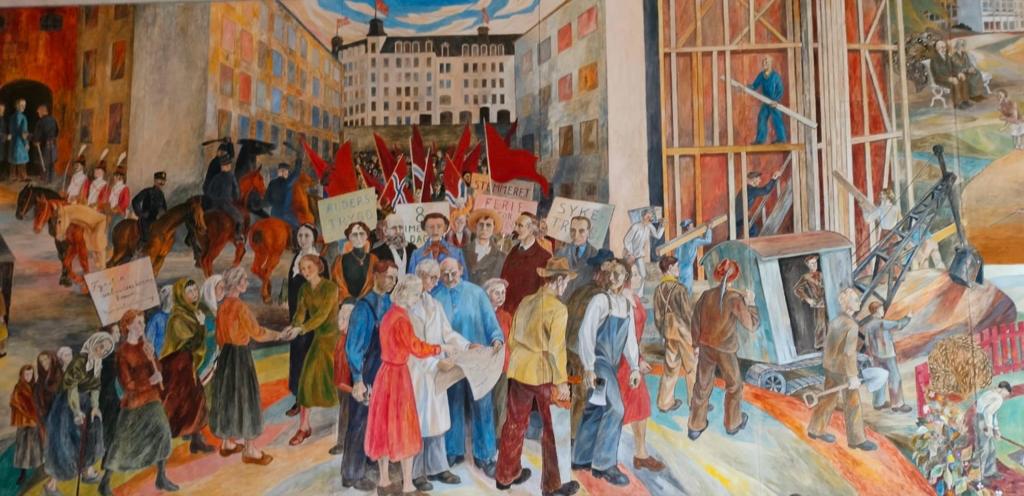
    It was a freezing morning in Oslo when I visited the Oslo City Hall with my parents. I was expecting an imposing seat of power with intricate gothic details carved on to the building, especially since it is the annual host of the Nobel Peace Prize ceremony. The glimmering clean and modernist architecture in the neighborhood overlooking the Oslo Docks only heightened my expectations, yet the City Hall building was a letdown. The building was brick red and featured a clock, while the interior was adorned by murals in a rather empty hall. I wondered, for the host of the Nobel Peace Prize ceremony, this building was underwhelming. Where was the exclusivity which was attached to anything important and highly respected?

    The murals answered. They showed scenes of communal harmony. They portrayed the muscled laborers of the city as proud, high and deservedly so. The heroes of the epic of the city of Oslo were not mythical warriors or royalty who decreed the construction of grandiose monuments, but they were instead the workers who made those monuments with their bare hands, and they were the chief guests. The stories portrayed were of life, death, marriage, revelry, hardship, rebellion against Nazi occupation, and the stars were the extraordinary citizens of Oslo. The stories were of solidarity. The murals reflected the psyche of the population of a country held as a model in human development  for the rest of the world. This was an individualistic society, but not a selfish society. The welfare of the population was the responsibility of a government which imposes high taxes, and doles out higher welfare schemes. They are not despised as free handouts by the populace, but they are thought of as responsibility to ensure basic necessities and dignity to fellow compatriots. This was a society where an unlocked door does not invite thieves, but trust. This was a utopia in reality, this was a society in peace.

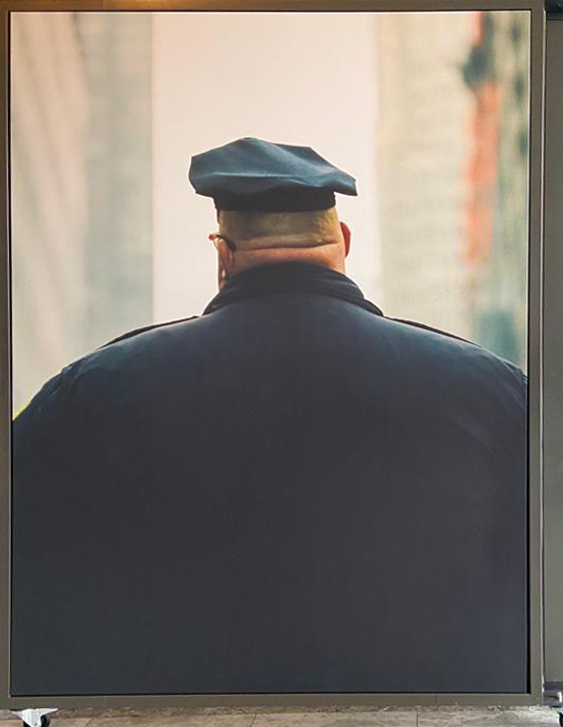
    There was an exhibition, if you will, displaying the various protests, uproar against political and social oppression around the world. They featured masked protesters fighting against the mask which silences them, a single yet hefty police boot adorned with a dark, metallic brace enough to strike fear and pain to those who dare to go against, the massive figure of a policeman turning his back to the viewers and the people, masked protestors fighting for freedom of expression and dignity. The answer to why Oslo hosts the Nobel Peace Prize was clear to me: dissent is respected and taken for granted. This accommodation, this lack of brute force gagging the voice of the people has brought peace. Peace in such a society is not merely order imposed by a higher power, but a mutual, unanimous willingness to live and let live, and I feel that we should strive to achieve that kind of peace. Peace should be one of dignity, freedom to talk responsible and one of mutual respect, not one where silence and immobility through gags and shackles is confused for peace.

    Humanity is one of imperfection and double standards, and I will not pretend to be different. I have also relished thoughts of silencing a few voices I felt not worthy of being heard of. Though one must act responsibly, without endangering the liberty and dignity of others, there must be a less biased filter of judging which voice is seditious and harms order, or more importantly peace. Peace, for me thus, is freedom and equal dignity to all those who deserve it regardless of external characteristics which do not define and decide a person’s worth, values and behavior. The struggle for liberation is one which has occurred countless times in the past, are still ongoing, and shall continue into the future. That struggle is barely ever non-violent. Blood has been spilled in these revolutions, rockets still fire instead of crackers of celebration, to maintain “order”. Peace is born from chaos, and order is an illusion.

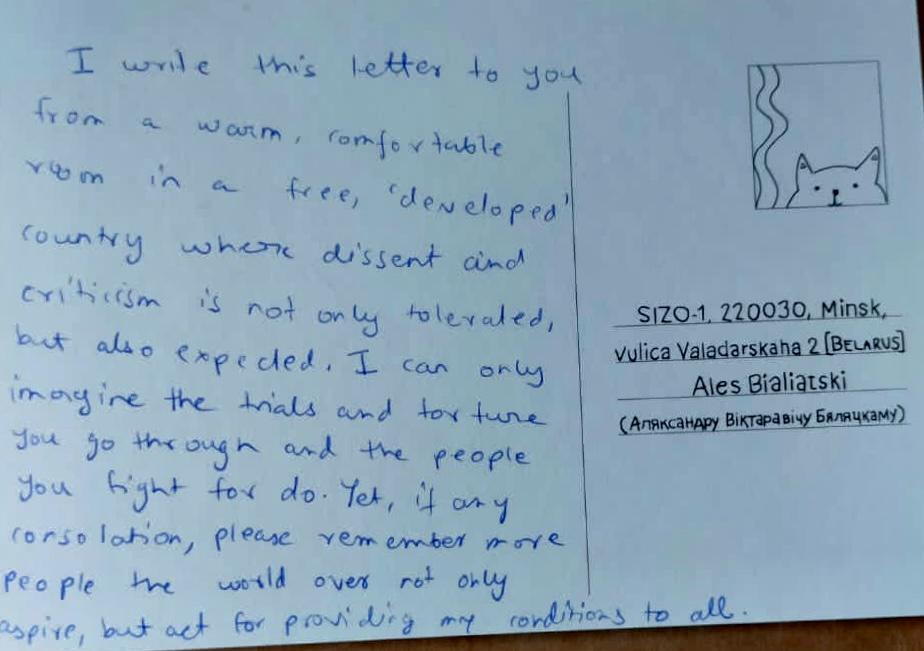
    Ales Bialitski is a Belarussian pro-democracy activist. He has worked to promote democracy and human rights in Belarus since 1980s, the only continental European country which is not a democracy. He fights for dignity and freedom for his people, for true peace. Yet the Peace Prize winner is jailed by the tyrant of his country instead of being honoured. The city hall had provisions to send postcards to this wronged participant in his country’s  struggle for liberation. I did feel guilty, as writing a mere postcard is vastly different from braving police batons and hoses to bring about said liberation. Yet, I felt, in my pain of not experiencing enough pain (if that makes sense), that if writing a mere postcard which may not even wind up in his cell to restore his faith in the struggle he believes in may make a difference, no matter how miniscule, then I shall write him a postcard to his, I believed cold jail cell, from my insulated surrounding, wearing a fuzzy jacket.

    This was my first, no matter how distant, interaction with a real-time political struggle. This mere composition of a postcard had reinforced my commitment to study human society, its intricate governance to a great deal,  reinforcing my fascination with the good, the ugly and the terrible of the human race. I felt that the future is human, a future of peace which we can achieve against all odds.

    Humanity has the ability to destroy itself. Humanity has the Holocaust, the Rape of Nanking and the Rwandan Genocide. Humanity also has the highest capacity to save itself from the most imminent of disasters. Humanity has the UNICEF, Ales Bialitski, Schindler and the kind neighbor next door. Humanity has the love of power which makes me pity the world, while humanity has the power of love which makes me want to preserve this world by all means.

    I believe that before a wildfire or a tsunami, humanity has the most capability to destroy itself from within. I also believe that humanity is the most capable of removing factory farming, animal abuse, Apartheid anywhere in the world, as we have been proven to do so. Whatever the price of peace, humanity can pay it.